If you want longer, fuller hair without committing to a completely different hairstyle, tape-in hair extensions are worth considering. They sit close to the head, can create extra length or volume, and come in a surprisingly wide range of colours and finishes.
But there is a catch: buying the first set that looks good in a photograph is rarely the best approach.
Your natural hair type, desired length, colour, density, lifestyle, and maintenance routine all matter. So does the way the extensions are applied and removed.
This guide walks through the important details. You’ll learn what tape-in extensions are, how they work, how to choose human hair tape extensions, what happens during application, how long they can be worn, and how to care for them properly.
What Are Tape-In Hair Extensions?
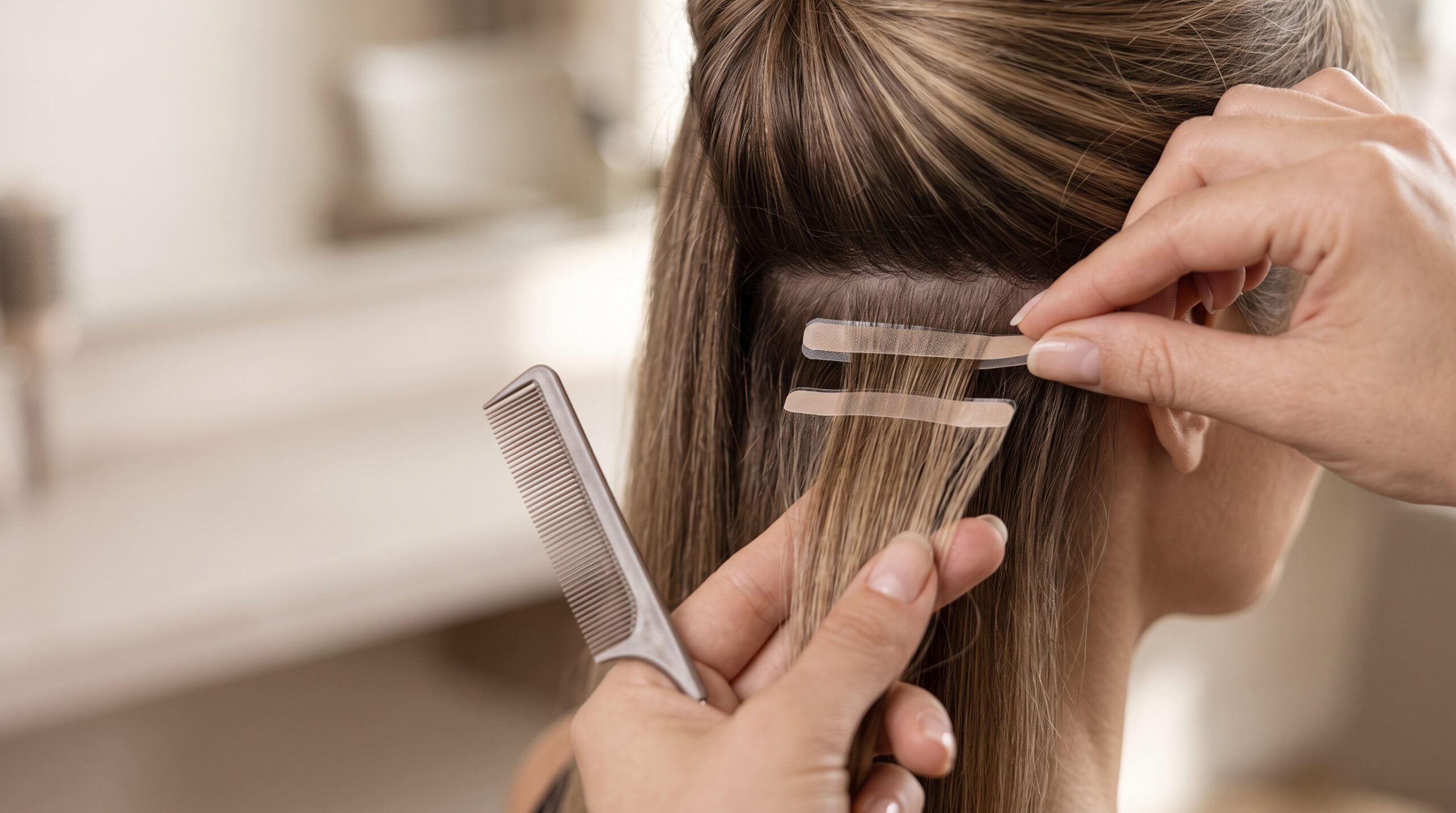
Tape-in hair extensions are sections of hair attached to your natural hair using adhesive strips. Rather than using clips, beads or heated bonds, the extension is secured with a thin tape system.
A common application method involves placing a section of natural hair between two adhesive extension pieces. The result is a flat attachment that sits close to the scalp.
That flat profile is one reason tape extensions have become popular. A well-placed extension should blend into the surrounding hair instead of creating a bulky attachment that announces itself every time you move your head.
The hair itself can also make a major difference.
Synthetic extensions can look realistic at first, but they often require different styling and care than natural hair. Human hair tape extensions, on the other hand, tend to move, feel and style more like your own hair. Hickenbick Hair’s tape collection features 100% human hair, including professional Indian Remy hair and luxury European and Russian hair ranges. With a wide selection of colours and styles, you can find an option that blends naturally with your own hair, whether you prefer classic shades or a deeper look with black tape hair extensions.
What does “Remy hair” mean?
Remy hair is a term you’ll see frequently while shopping for premium hair extensions.
In simple terms, it refers to human hair collected and prepared with the cuticles kept aligned in the same direction. This preparation can help produce a smoother feel and reduce problems associated with cuticles running in different directions.
Quality still varies between products, so “Remy” should not be treated as a magic word. Look at the complete product description, hair origin, processing, construction and care requirements.
What can tape-in extensions do?
The answer depends on what you want from them.
You might use tape extensions to:
- Add noticeable length
- Increase overall volume
- Add fullness around the sides
- Blend shorter layers
- Create a thicker-looking ponytail
- Introduce balayage or ombre colour
- Experiment with a different shade without colouring all your natural hair
- Add subtle highlights
- Create a fuller appearance without a major haircut
Hickenbick’s current collection includes slim professional tape-in extensions in 18- and 23-inch options, luxury European/Russian 20-inch extensions, invisible tape-in products and additional classic and fantasy shades. The collection also offers different colour families, including natural, highlighted, balayage and ombre choices.
That variety matters because there is no single “best” tape extension for everyone.
A person with fine, shoulder-length blonde hair who wants a little more fullness has a very different requirement from someone with thick brown hair who wants dramatic length.
A quick look at the options
| Type | Best suited to | Main consideration |
|---|---|---|
| Slim tape-in extensions | A flatter, discreet attachment | Good colour matching is important |
| Invisible tape extensions | A particularly subtle appearance | Choose carefully based on hair density and colour |
| Human hair tape extensions | Natural movement and styling | Need regular care |
| Remy tape extensions | People prioritising hair quality | Quality varies by product |
| Balayage/ombre tape extensions | Blended colour effects | Match the transition to your existing colour |
| Fantasy tape extensions | Creative colour changes | Consider how the shade works with your natural hair |
The goal is not to find the most expensive option. It is to find the option that makes sense for your hair and the result you have in mind.
Why Hair Type, Length and Colour Matter So Much
Imagine ordering a pair of shoes online without checking the size. They might look fantastic. They still won’t work.
Hair extensions are similar.
The colour may be perfect, but the length could be excessive. The length may be right, but the weight or attachment style may not suit your hair. Or everything could seem correct until the extensions are fitted and the blend looks noticeably different from what you expected.
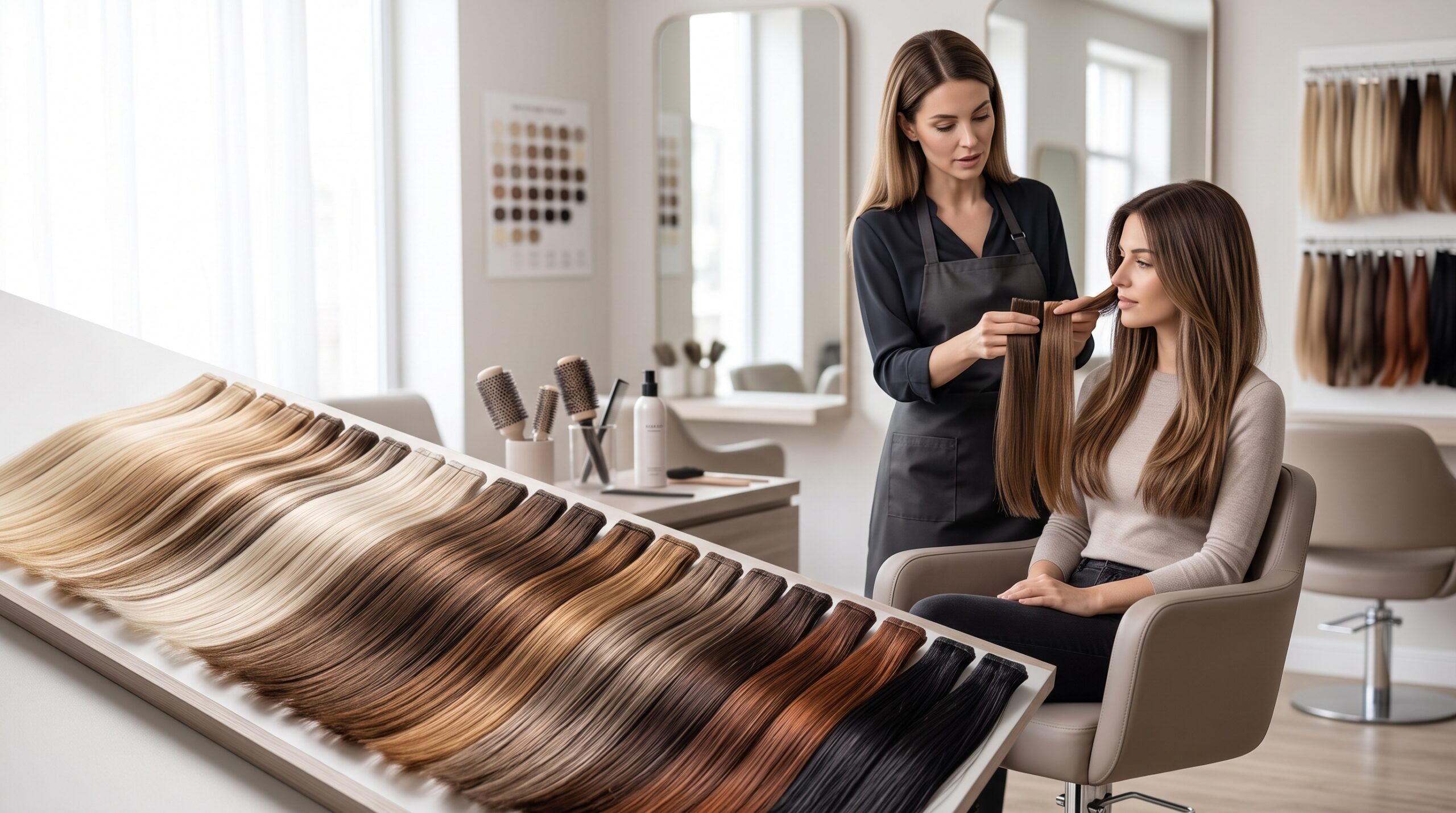
Start with your goal
Before looking at colours or lengths, ask one simple question:
What am I trying to change?
If your natural hair already has the length you like but looks a little flat, you may mainly want volume.
If your hair is short and you want a longer style, length becomes the priority.
If you want both, you’ll need to consider how much additional hair is appropriate for your natural density.
| Your goal | What to consider |
|---|---|
| More volume | Placement, density and weight |
| More length | Extension length and blending |
| Length + volume | Overall quantity and balance |
| Highlights | Colour placement and shade matching |
| Balayage | Gradient and existing hair colour |
| Temporary colour change | Creative or fantasy shades |
Choosing the right length
Tape-in extensions commonly come in different lengths. Hickenbick currently offers professional tape-in options at 18 and 23 inches, while its luxury slim tape range is available at 20 inches.
Longer is not automatically better.
A very long extension on shorter or finer natural hair can require more blending. It may also create a bigger difference between your own ends and the added hair.
For a natural-looking result, think about proportion.
An 18-inch extension can provide meaningful length while remaining relatively easy to blend for many hairstyles. A 20-inch option gives you more length without moving immediately into the longest category. A 23-inch extension creates a more dramatic result.
Your stylist can also help decide where the extensions should stop and how your natural layers should be blended.
Choosing the right colour
Colour matching deserves more attention than many first-time buyers give it.
A shade that looks correct on a product page may appear different beside your natural hair. Lighting, screen settings, roots and existing highlights can all affect the result.
Look beyond the overall colour.
Consider:
- Your root shade
- Mid-length colour
- Ends
- Warm or cool undertones
- Highlights
- Balayage
- Ombre transitions
- Natural regrowth
- Whether your hair changes colour in different lighting
Hickenbick’s current tape range includes dozens of colour choices across its different products. Its professional slim tape range lists 41 colours, while the luxury European/Russian slim range lists 38 and the invisible range 37.
That broad selection can be useful when your hair does not fit neatly into “blonde,” “brown” or “black.”
What about fine or thin hair?
This is where a sensible approach matters.
Fine hair has a smaller individual strand diameter than coarse hair. That doesn’t automatically mean you cannot wear extensions. It does mean that attachment, placement and added weight deserve careful consideration.
A good extension installation should work with your natural hair rather than asking it to carry an unreasonable load.
If your hair is already fragile, breaking or noticeably thinning, it makes sense to speak with a qualified stylist before adding extensions.
There is also an important difference between normal shedding and hair loss. The American Academy of Dermatology says that shedding 50 to 100 hairs per day can be normal.
So finding loose hairs during washing does not automatically mean your extensions are causing a problem.
How much hair do you need?
There is no universal number.
Someone with fine hair who wants subtle volume may need considerably less than someone with dense hair who wants a dramatic length increase.
Instead of asking, “How many tapes should everyone use?” ask:
“How much additional hair will create the result I want without overwhelming my natural hair?”
That is a much better starting point.
How Are Tape-In Hair Extensions Applied?
Tape-in extensions are popular partly because the application process can be relatively quick compared with some other extension methods.
The exact process depends on the product and the stylist, but the basic idea is straightforward.
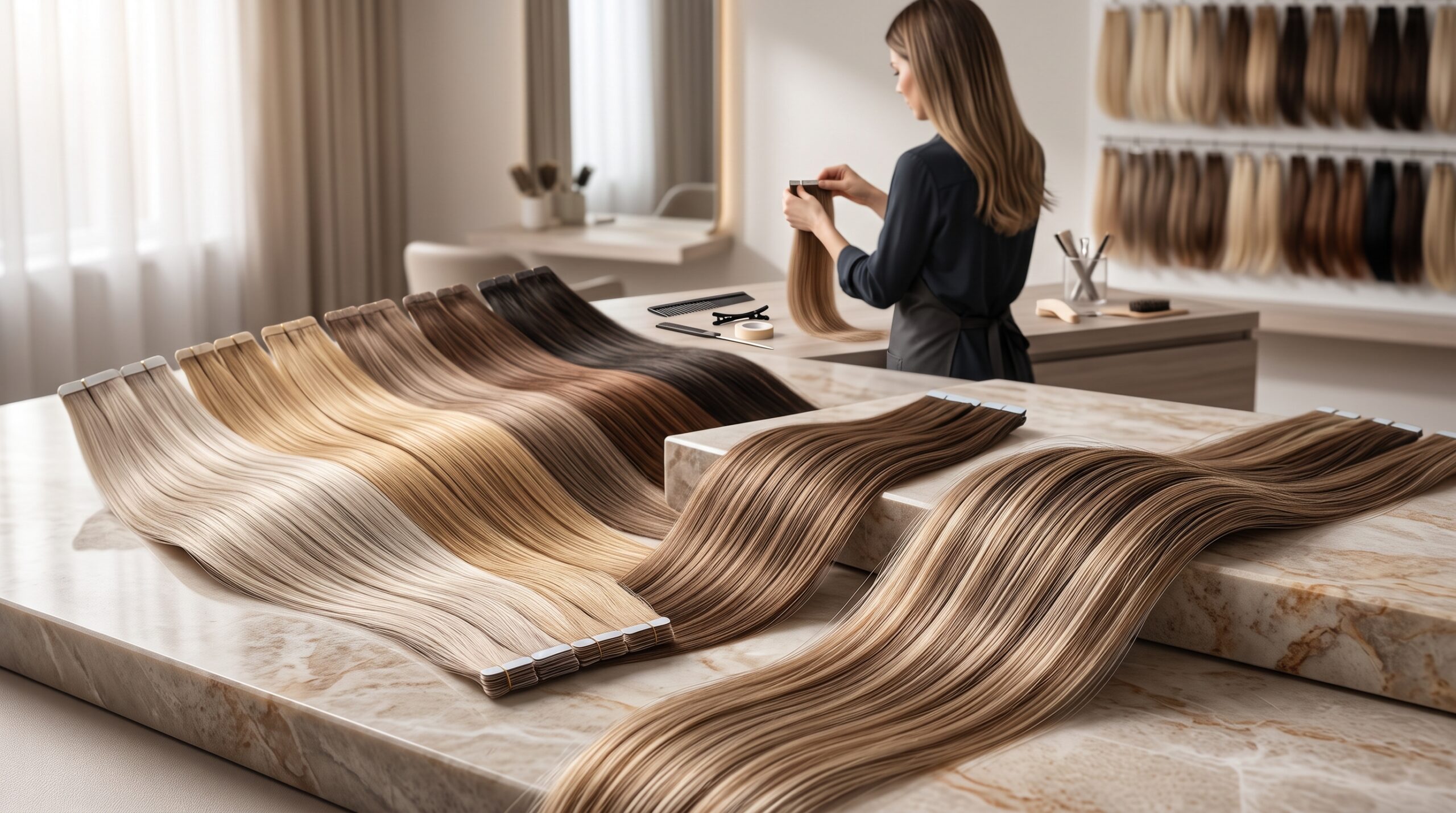
Step 1: Prepare the natural hair
The hair should be clean and free from products that could interfere with the adhesive.
The stylist sections the hair carefully. Placement matters. Extensions should not be attached directly onto the scalp, and the section needs to contain enough natural hair to support the extension appropriately.
Step 2: Create a clean section
The stylist separates a thin, controlled section of natural hair.
This is where experience makes a difference.
A section that is too thick can affect how the tape sits. A section that is too thin may place too much strain on the hair supporting the extension.
Step 3: Position the extension
One adhesive piece is positioned underneath the selected section.
The natural hair is placed over the adhesive area, and the second extension piece is positioned above it.
This creates the familiar “sandwich” attachment.
Hickenbick’s slim tape products are promoted as having a flat adhesive strip and application without heat. The collection also offers a specific application tool and a separate thermal application option for products intended for heat-based application.
Step 4: Secure the bond
The two adhesive surfaces are pressed together according to the product’s instructions.
The bond needs to be secure, but secure does not mean painfully tight.
That distinction matters.
The American Academy of Dermatology warns that repeated pulling on hair can cause traction alopecia. Its guidance also gives a very simple rule: if a hairstyle hurts, it is too tight.
Tape extensions are no exception to the broader principle that excessive tension is something to avoid.
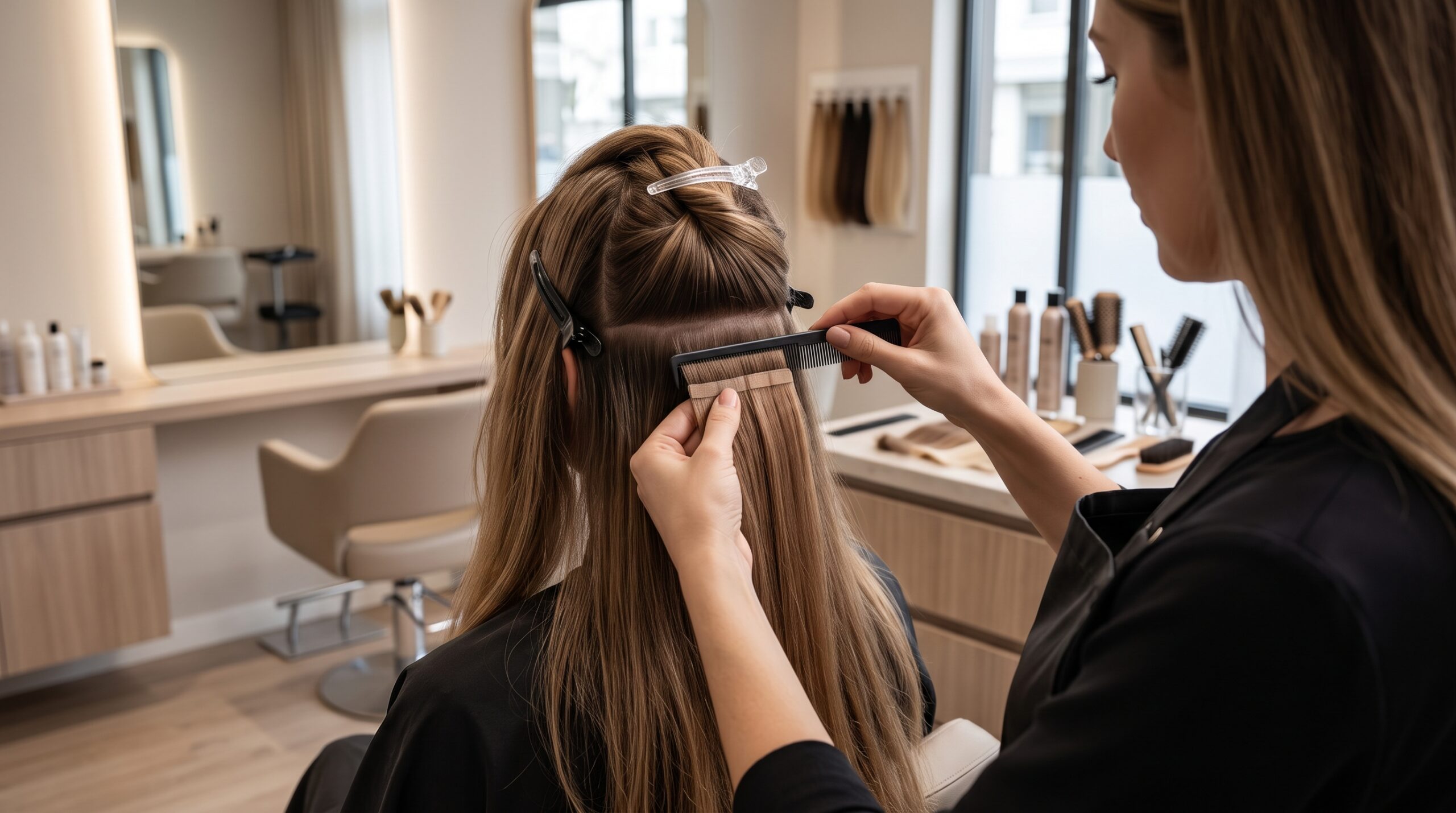
Should you apply tape extensions yourself?
It depends on the product, your experience and the result you want.
Some tape-in systems are marketed as simple to apply, and Hickenbick says its products can be applied without professional assistance.
However, professional application can make sense if:
- It is your first time
- Your hair is fine or fragile
- You need complex colour blending
- You want a layered or highly customised result
- You are unsure about section size
- You have had problems with extensions in the past
- You need help with removal and reapplication
Think of it like cutting your own fringe. Technically possible? Yes. Always the best idea five minutes before an important event? Probably not.
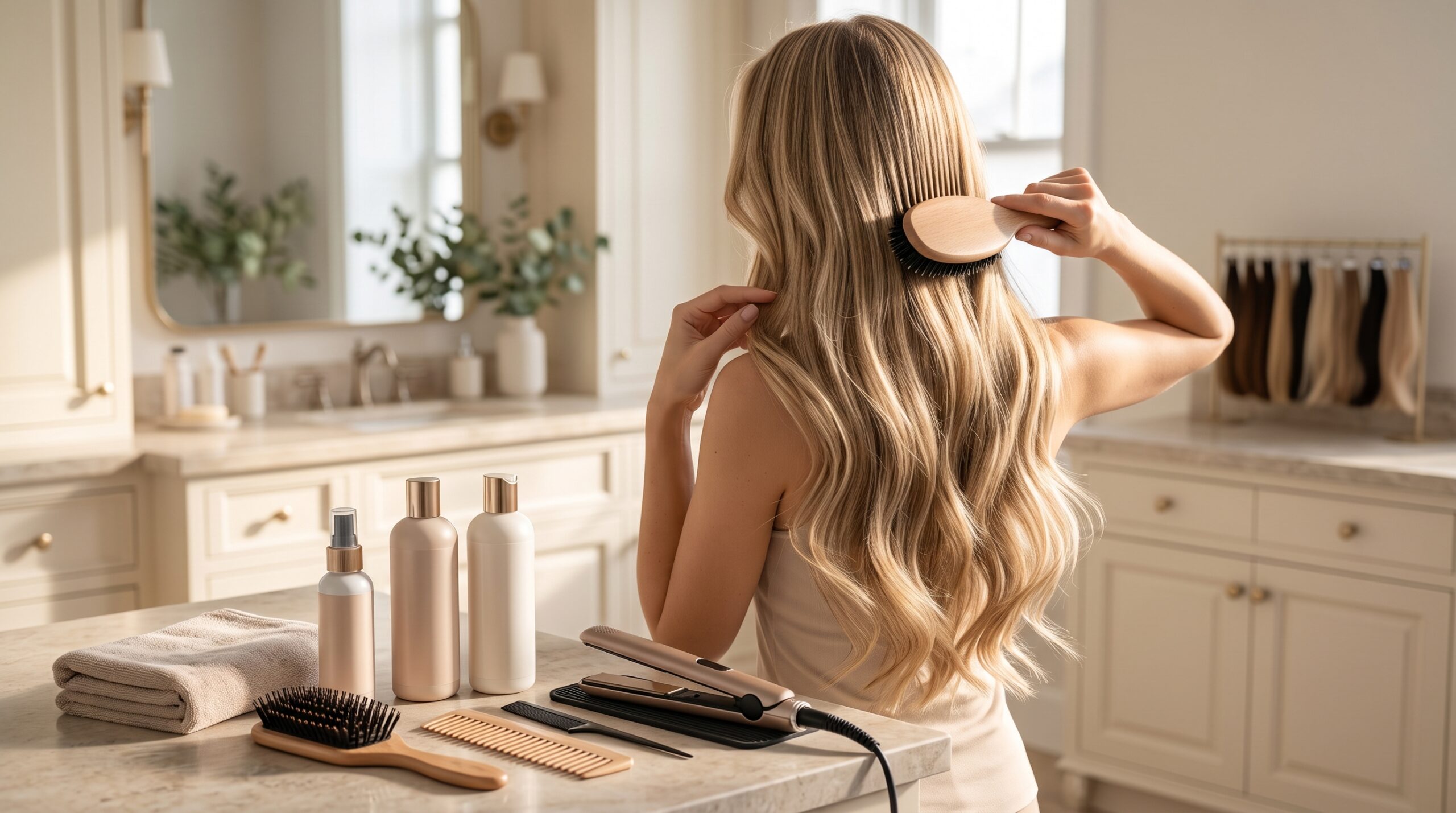
How Long Do Tape-In Hair Extensions Last?
This question sounds simple, but it has two different answers.
How long do they stay attached?
And:
How long can the extension hair itself be reused?
Those aren’t the same thing.
Hickenbick recommends having its tape extensions moved up around every eight weeks, noting that faster-growing hair may need attention sooner. The company also says that human hair extensions can be reused several times with appropriate care and replacement adhesive.
Why does the hair need to be moved?
Because your natural hair keeps growing.
According to NCBI’s InformedHealth resource, scalp hair grows at roughly 1 cm per month.
That means an extension that starts close to the scalp gradually moves farther away as your natural hair grows.
After several weeks, the attachment is no longer sitting where it was originally placed.
What affects how long extensions remain in good condition?
Several factors play a role:
- Natural hair growth rate
- Washing frequency
- Haircare products
- Brushing habits
- Heat styling
- Swimming
- Sleeping habits
- Exposure to chlorine or salt water
- How carefully the extensions are removed
- Quality of the extension hair
- Quality of the adhesive
- How well the extensions were applied
The extension hair itself does not grow. Once it has been cut from the scalp, it no longer receives nutrients from a follicle.
That means your treatment of the lengths and ends matters.
Can tape extensions be reused?
Many human hair tape extensions can be reused if the hair remains in good condition and the attachment system allows it.
The adhesive itself generally needs to be replaced.
Hickenbick sells replacement tape, refill bands and replacement tabs specifically for its tape-extension systems.
Its basic reuse process involves removing the extensions with a suitable remover, cleaning the bond area, removing old adhesive and applying fresh tape before reapplication.
This is one reason buying good-quality human hair can make sense over time. The initial purchase is only part of the equation. Maintenance matters too.
How to Care for Tape-In Hair Extensions
Good hair extensions can still become a tangled mess if you treat them like an indestructible mop.
A simple routine makes a big difference.
Brush carefully
Start at the ends and work upward.
Don’t yank through knots from the roots.
An extension brush can help because it is made specifically for working through extension hair while reducing unnecessary pulling. Hickenbick offers professional extension brushes alongside its tape accessories.
A useful routine is:
- Separate large tangles gently with your fingers.
- Begin brushing at the ends.
- Gradually work higher.
- Hold the hair near the attachment when brushing around the bond.
- Avoid aggressive strokes across the adhesive area.
Wash with care
Your natural hair and extension hair need to be cleaned, but the attachment area needs attention too.
Follow the care instructions supplied with your particular extension system and products.
Avoid saturating the adhesive unnecessarily. Don’t scrub the bonds aggressively.
Work shampoo through the hair gently, rinse thoroughly, and condition the lengths rather than placing heavy conditioning products directly on the adhesive area unless the product instructions say otherwise.
Be sensible with heat
Human hair can generally be styled more like natural hair than synthetic fibre, but that doesn’t mean unlimited heat is a good idea.
The American Academy of Dermatology advises limiting hot tools because excessive heat can weaken hair.
For extensions, sensible habits include:
- Use heat protection.
- Choose a moderate temperature.
- Avoid repeated passes with straighteners.
- Don’t press hot tools directly against adhesive.
- Allow hair to dry properly.
- Follow the extension manufacturer’s instructions.
Sleeping with extensions
Going to bed with wet, tangled hair is asking for trouble.
Before sleeping:
- Make sure your hair is dry.
- Brush gently.
- Detangle the lengths.
- Keep the hair loosely secured if recommended for your extension type.
- Avoid creating unnecessary tension around the attachments.
The goal is simple: reduce rubbing, tangling and pulling while you sleep.
Swimming
Chlorinated and salt water can affect hair quality and make tangling more likely.
If you swim regularly, ask your stylist or extension supplier for care instructions suited to your specific system.
Tie the hair back gently, avoid unnecessary rubbing, and rinse it after swimming.
A little preparation can save you a lot of detangling later.
Can Tape-In Hair Extensions Damage Your Natural Hair?
This deserves an honest answer.
No extension method should be described as completely risk-free.
DermNet, a dermatology resource associated with dermatology professionals, lists hair extensions among practices that can contribute to traction alopecia, a form of hair loss caused by prolonged or repetitive tension on the hair.
That doesn’t mean everyone who wears tape extensions will develop hair loss.
It means that tension, weight, placement, duration and hair condition matter.
The American Academy of Dermatology also warns that repeated pulling from hairstyles and extensions can lead to traction alopecia.
Warning signs worth paying attention to
Don’t simply push through discomfort.
Watch for:
- Pain
- Persistent scalp tenderness
- Redness
- Itching
- Broken hairs around attachment points
- Noticeable thinning
- Increasing sensitivity
- Extensions pulling strongly on the scalp
If something hurts, stop and have the installation checked.
DermNet notes that early traction alopecia may initially occur without scarring, while prolonged and excessive tension can damage follicles and result in permanent hair loss.
That is why proper fitting and maintenance matter more than simply choosing a fashionable extension.
A useful study to put the issue in context
A peer-reviewed study of 223 women attending hair salons in Yaoundé, Cameroon found traction alopecia in 34.5% of participants. Regular extension use was reported by 95.1% of the women studied.
Those numbers should be interpreted carefully.
This was a specific study population in Yaoundé. It does not mean that 34.5% of all women who wear extensions develop traction alopecia.
Still, the findings reinforce an important point: extension practices deserve attention, especially where repeated tension is involved.
If you already have unexplained hair loss, scalp problems or fragile hair, speak with a dermatologist or qualified hair professional before using extensions.
Tape-In vs Other Hair Extension Methods
Tape-ins aren’t the only option.
Different extension systems suit different lifestyles.
| Method | Application | Best for | Main advantage |
|---|---|---|---|
| Tape-in | Adhesive tabs | Longer-term wear | Flat, discreet attachment |
| Clip-in | Clips | Occasional styling | Easy to remove |
| Keratin/pre-bonded | Bonded attachment | Longer-term wear | Individual strand placement |
| Weft | Sewn, bonded or otherwise secured | Added volume | Larger sections of hair |
| Microring | Small rings/beads | Longer-term wear | No adhesive in some systems |
| Halo | Wire/hidden band | Temporary wear | Quick installation |
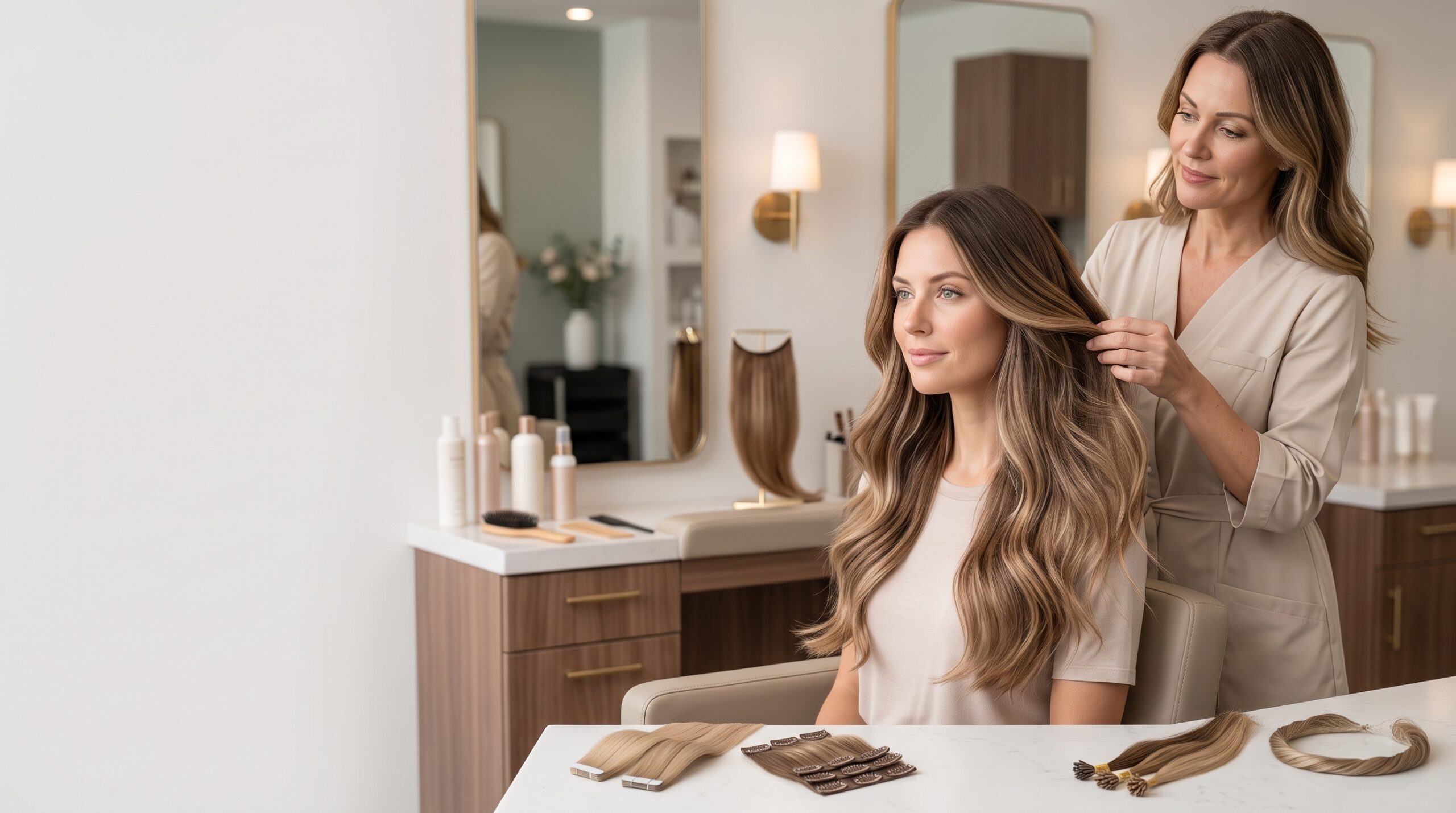
Tape-in vs clip-in extensions
This is one of the most common comparisons.
Clip-ins are convenient if you want to add length or volume for an evening, event or occasional hairstyle. They can be removed at the end of the day.
Tape-ins are better suited to people who want a more continuous hairstyle without applying clips every morning.
Neither is automatically better.
If you love changing your look and removing extensions frequently, clip-ins may make more sense.
If you want a semi-permanent solution that stays in place between maintenance appointments, tape-ins may be more appealing.
Tape-in vs keratin extensions
Keratin or pre-bonded extensions attach individual strands using a bonded tip.
This can allow detailed placement, but the application and removal process differs from tape extensions.
Tape-in systems use wider adhesive pieces, while pre-bonded systems offer more individual strand placement.
Your stylist can help determine which method works best with your natural density and preferred hairstyle.
Tape-in vs weft extensions
Wefts are larger sections of hair. They can be useful when the goal is substantial volume.
Tape-ins, by comparison, use smaller adhesive pieces and can offer more flexibility in placement.
Again, the right answer depends on the person wearing them.
Common Tape-In Extension Mistakes to Avoid
Even good-quality hair can give disappointing results if the basics are overlooked.
1. Choosing a colour from a screen alone
Screens are unreliable for precise colour matching.
Use colour-matching support where available.
2. Buying the longest option automatically
More length means more blending work. It also changes the overall visual balance.
Choose based on your target style, not the number printed on the product.
3. Ignoring natural hair density
Fine hair needs a thoughtful approach to weight and placement.
4. Applying extensions too close to the scalp
The attachment needs appropriate positioning. Your scalp and natural hair should not be placed under unnecessary tension.
5. Brushing aggressively
Pulling through tangles is a fast route to breakage.
Start at the ends.
6. Using excessive heat
Human hair can be styled, but heat still takes a toll.
7. Leaving extensions in past their maintenance point
As natural hair grows, the attachment moves away from the scalp.
Hickenbick recommends moving its tape extensions up around every eight weeks, with timing adjusted according to hair growth.
8. Removing them carelessly
Don’t pull or rip adhesive extensions out.
Use an appropriate removal product and follow the manufacturer’s instructions.
Hickenbick’s tape range includes dedicated removal sprays and removers, along with replacement adhesive products for reapplication.
9. Ignoring discomfort
Pain is not something you should simply accept as part of wearing extensions.
If the scalp feels sore or the hair is being pulled, get the installation checked.
Choosing Your Tape-In Hair Extensions
By now, the decision should feel much simpler.
Instead of asking, “Which tape-in extensions are the best?” ask five smaller questions.
1. What result do I want?
Length? Volume? Both? Colour?
Start there.
2. What is my natural hair like?
Consider:
- Fine or thick strands
- Overall density
- Straight, wavy or curly texture
- Current length
- Condition of the ends
- Existing colour treatments
3. Which hair quality fits my needs?
If a natural appearance and styling flexibility are priorities, human hair is worth considering.
Hickenbick’s collection includes professional Indian Remy hair and luxury European/Russian human hair options.
4. Which attachment style suits my look?
Slim tape provides a flatter profile. Invisible tape is aimed at an especially discreet appearance.
The choice should also take your hair density and colour into account.
5. Am I prepared for maintenance?
Tape extensions aren’t a “put them in and forget about them” purchase.
You’ll need to brush carefully, wash thoughtfully, monitor the attachments and arrange maintenance as your natural hair grows.
Hickenbick’s tape accessories collection includes replacement tape, refill tabs, removers, removal spray, application tools, brushes and other equipment intended for tape-extension maintenance.
That matters because accessories are part of the ownership experience, not an afterthought.
Final Thoughts
Tape-in hair extensions can be a practical way to add length, volume or colour without changing your natural hairstyle completely.
The trick is to stop thinking of the purchase as simply “buying hair.”
You are choosing a combination of hair quality, length, colour, attachment method and maintenance routine.
For some people, a subtle 18-inch set will create exactly the right amount of fullness. Someone else may want a longer 20- or 23-inch look. Another person may care more about an invisible attachment or a carefully blended balayage shade.
There is no single answer.
Start with your natural hair. Decide what you want to change. Then choose the extension type that fits those two things.
And don’t forget the boring stuff. Proper brushing, sensible heat use, timely maintenance and careful removal can make a much bigger difference to your experience than a flashy product description ever will.
For shoppers looking for human hair tape extensions, Hickenbick Hair currently offers a broad selection of slim, invisible, professional, luxury and fantasy tape-in options, along with the tapes, removers, brushes and application accessories needed to maintain the system.
The best extension result is usually the one nobody notices.
They simply notice that your hair looks great.